Consortium workshop — 30 April 2026·Prepare here →
Ure Dales LRS
30 Apr →

The 4 Returns in Ure Dales

A framework that measures success for 18 landowners and their families alongside the land they live on. Four returns, three zones, twenty years.

12 min read

Why this framework at all

The 4 Returns framework was developed by , a Netherlands-based organisation that works on long-horizon landscape restoration with communities around the world. Ure Dales is not a Commonland project — we are adopting the framework because it fits the shape of what we are trying to do, and because it insists on something the usual agri-environment vocabulary tends to skip: that a landscape in decline is losing more than habitat.

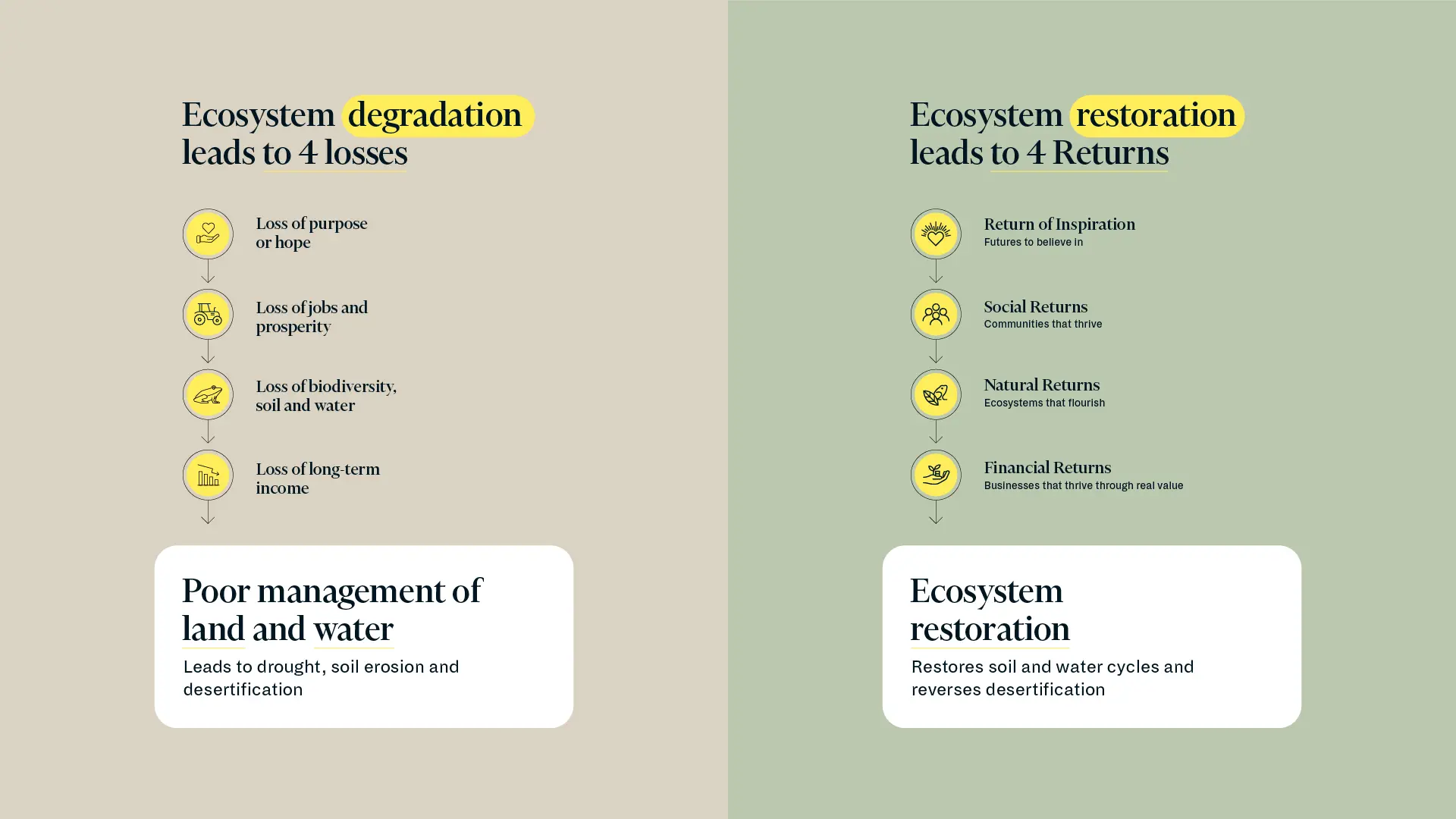
Commonland frames that decline as four losses — of hope, of social networks, of biodiversity, and of economic value. The four returns are a direct answer to those four losses. Any one on its own is a partial fix. All four together is a landscape that stays inhabited, stays farmed, and stays alive.

For the Ure Dales, all four losses are live risks on a long enough time horizon: a generation of under-investment in peat and pasture; holdings where the adult children have moved away; farming incomes that have narrowed against input costs; a sense among some that the future is being decided elsewhere. A 20-year has to answer all four or it answers none.

Infographic: the 4 Losses (hope, social networks, biodiversity, economic value) mapped to the 4 Returns (inspiration, social, natural, financial).
The 4 Losses answered by the 4 Returns. Infographic: Commonland · commonland.com/4-returns-framework

The four returns

Each return answers one of the four losses. For each, Commonland’s one-line definition, then what it means in practice on a Ure Dales holding.

Return of Inspiration

Giving people hope and a sense of purpose.— Commonland

For a Ure Dales landowner, this is the return that is hardest to put a number on and easiest to feel. It is the difference between handing on a holding that has been running down for a generation and handing on one that has been brought back — peat wetter, becks cleaner, woodland re-established on the right ground, stock healthy on the right ground too.

It is also the appetite of adult children to come home, or to stay. The family guide is explicit about this: a 20-year scheme is long enough that the children on the holding now will reach adulthood inside it. Whether they see a future in the dales at the end of it is partly shaped by what the next twenty years look like on the ground.

Measured in stories, in uptake, in who stays on and who comes back.

Return of Social

Bringing back jobs, education and social connections.— Commonland

For Ure Dales, Social Return is the Consortium itself — 18 landowners sitting at the same table as Yorkshire Wildlife Trust, deciding together, with consent-based governance and a landowner majority. It is the Independent Audit & Standards Committee. It is shared services — procurement, vet, insurance, training — that lower the cost of running each holding.

Beyond the scheme, it is the dales community staying inhabited: the primary school, the pub, the market, the contractor network. The scheme is designed so holdings remain lived on and worked; anything that hollowed out the valley would be a social loss regardless of ecological success.

Measured in shared-services uptake, consortium attendance, community programme activity, employment retained.

Return of Natural

Restoring biodiversity and soils for healthy and resilient landscapes.— Commonland

The one most people reach for first. For Ure Dales, Natural Return is the peatland and blanket bog of the moorland top, the rough grazing and in-bye in the middle, the becks and valley-floor habitats below. It is water held higher in the catchment for longer, soils that take rain instead of shedding it, species audits that show recovery rather than retreat.

The Year 1 baseline audit is what makes this honest. Nothing is assumed; everything is measured. Tier awards at Year 3 — and renegotiation at Year 10 to 12 — are tied to what the audit actually records, not to aspiration.

Measured through the Year 1 baseline, ongoing ecological monitoring, and tier audit against the trustmark standard.

Return of Financial

Realising long-term sustainable income for communities.— Commonland

This is the return that protects the holding as a business. For a Ure Dales landowner it is concrete: DEFRA Landscape Recovery as the core payment in Years 1 to 5; trustmark premium market access as it comes online; shared-services savings on insurance, procurement, vet, training; and blended private finance coming in to reduce DEFRA dependency from Year 5 onwards.

Financial Return is also what gives the scheme its honest exit. Without a credible income stack, exit after Year 3 would be a bluff. With one, it is a genuine option — which is precisely why it is written in.

Measured in holding-level income, scheme-level surplus, cost-per-hectare, and DEFRA-dependency trend.

The three zones — mapped to the dales

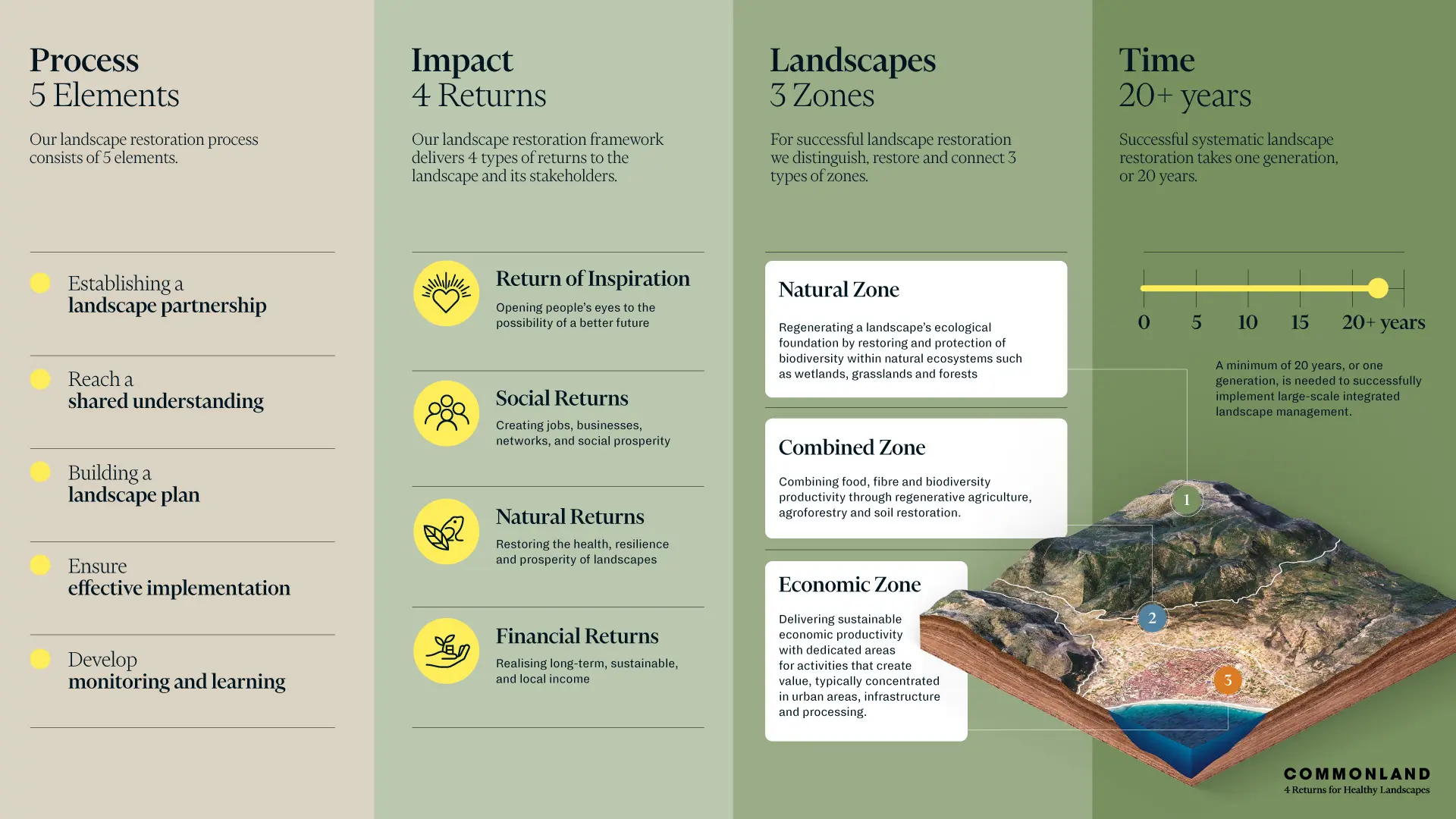
Commonland divides any landscape into three zones. In Ure Dales, the zones read off the land almost without argument — moorland top, in-bye middle, valley floor below. This is where the framework earns its keep: it lines up with the ground we already walk.

Infographic: the 4 Returns, 3 Zones and 20-Year horizon diagram from Commonland.
4 Returns, 3 Zones, 20 Years — the master diagram. Infographic: Commonland · commonland.com/4-returns-framework

Natural Zone — moorland top

Ecological regeneration. Native vegetation, water, biodiversity.

The peat, blanket bog and upland heath at the top of the holdings. Restoration-led: re-wetting, gully-blocking, bare-peat revegetation, careful management of grazing pressure.

Combined Zone — in-bye and rough grazing

Where regenerative farming and ecology overlap. Agroforestry, rotational grazing, mixed tenure.

The working middle of the holding. Where most of the farming happens and where most of the integration work sits — hedges, ghylls, pasture, trees on the right ground, stock on the right ground.

Economic Zone — valley floor

Where value is added and traded.

Settlement, markets, the built fabric, short supply chains. Where trustmark-premium produce reaches a buyer, where shared services are organised, where the dales meet the wider economy.

Why twenty years

Commonland is explicit that landscape transformation requires “at least a generation (20+ years)”. That single line is the reason the framework and a DEFRA Landscape Recovery scheme line up at all. Three- and five-year project cycles — the usual horizon — cannot recover a peat system, cannot re-establish woodland, cannot build the trust that makes a consortium of 18 holdings work.

The twenty years are not a vague stretch. In the Ure Dales design they carry specific milestones:

  • Year 1 — baseline audit across all 18 holdings. Nothing assumed; everything measured.
  • Year 3 — trustmark tier awards based on delivery against the baseline. First honest exit available without penalty from this point on.
  • Year 5 — blended private finance online, reducing DEFRA dependency.
  • Year 10 to 12 — mid-term renegotiation. The scheme is reviewed against what has actually happened, not what was hoped for.
  • Year 18 to 20 — wind-down protections and handover of what has been restored, so that no holding is left carrying cost without carrying income.

Twenty years is a weight. The family guide is honest about that: a 20-year commitment is longer than many careers and spans a generation. The young children on a holding now may be adults inside it; the older generation may not see the end of it. The scheme is designed to protect the signing landowner — exits, conditions, no scheme-imposed action on the land — but honesty about the horizon is not the same as softening it.

Trust, local leadership, start small — principles that protect landowners

Commonland’s published guidance for practitioners repeats a handful of short principles. Each of them maps onto a specific design feature of the Ure Dales scheme — not as a branding exercise, but because those principles were learned by people trying to do this work and discovering what went wrong when they didn’t hold.

“Trust is built slowly and destroyed quickly.”

— Commonland

This is why the Ure Dales scheme is consent-based, why there is a 14-day ratification window after the 30 April workshop, and why silence is not treated as consent. The Consortium is 18 landowners plus YWT, landowner majority; the Audit & Standards Committee is independent. None of that is decorative — it is what makes the trust possible to build in the first place and harder to shatter if one thing goes wrong.

“Local leadership makes solutions sustainable.”

— Commonland

The Single Legal Entity holds the DEFRA contract, but the delivery decisions on a holding are agreed with the landowner, not issued to them. Site-specific plans, not a uniform prescription. YWT’s role is partnership and assurance, not management. The people closest to the ground are the people deciding what happens on it.

“Think big, start small, act now.”

— Commonland

Year 1 is a baseline audit, not a bulldozer. The tier structure is designed so a holding can start at Bronze and move up as evidence and appetite allow. Exit is available without penalty after Year 3. No landowner is expected to bet the whole holding on the first step — the architecture of the scheme is built to take small steps that add up.

Working with the willing

Commonland describes its approach as building a “coalition of the willing” — not pressuring the undecided, not waiting for universal sign-up. For Ure Dales that means: a clear no is a legitimate answer, not a failure of the scheme. A “not yet” holds the door open on equivalent terms at a later date. The scheme is designed to proceed with whichever landowners ratify, and to remain credible if some do not.

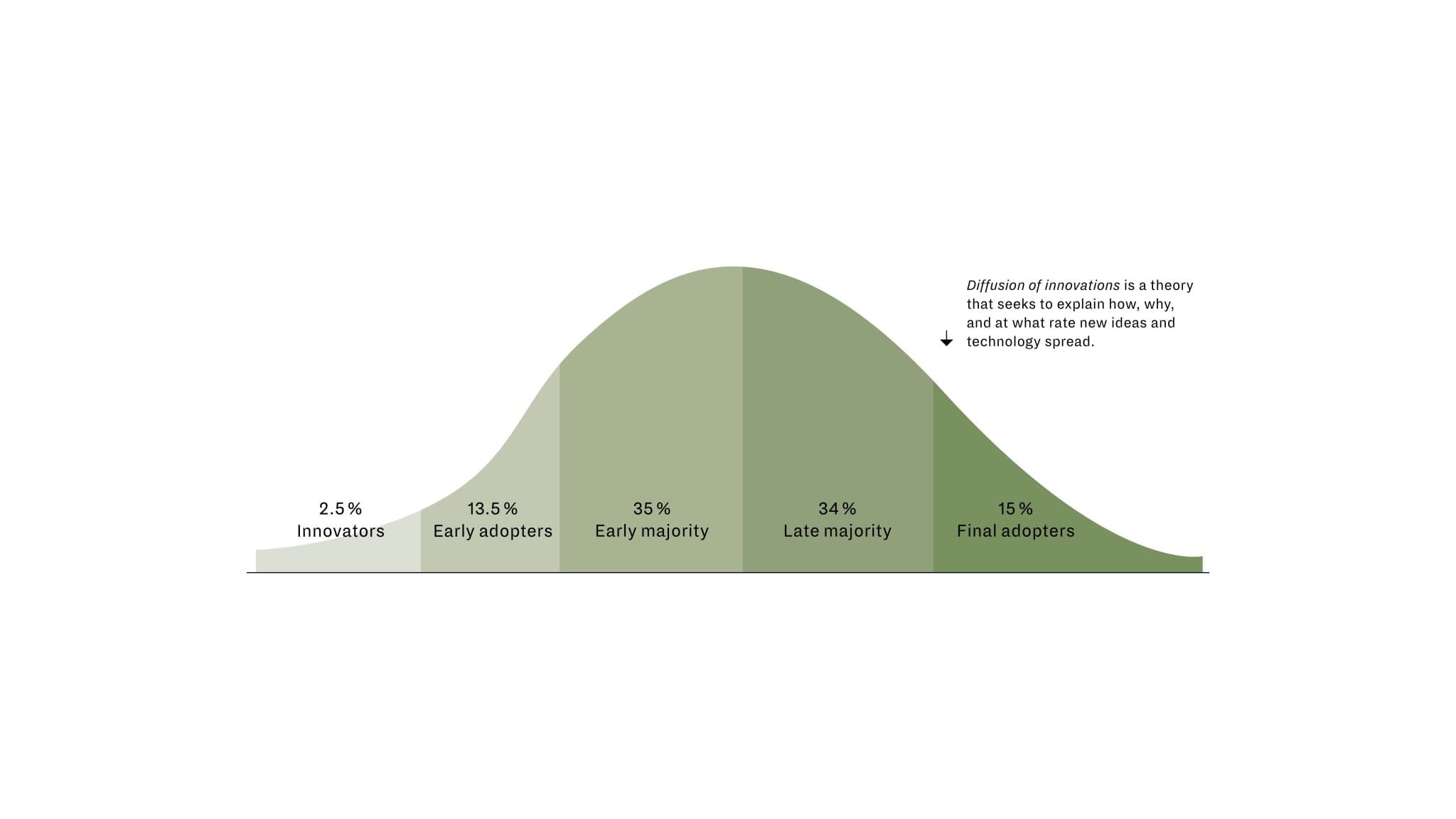
The diagram below — Rogers’ diffusion of innovation — is the long-established shape of how any new approach spreads through a community. Early adopters lead; the majority follow once there is evidence; laggards may or may not ever join. A scheme that insists on unanimity from day one is a scheme that will never start.

Rogers' Diffusion of Innovation curve: innovators, early adopters, early majority, late majority, laggards.
Rogers’ Diffusion of Innovation curve — the basis of Commonland’s “work with the willing” principle. Figure: Commonland · commonland.com/4-returns-framework

What this means for your holding

The 4 Returns framework is not a side interest in the Ure Dales scheme — it is the shape of how the scheme defines success. For your holding that means four things are measured in parallel, not one:

  • Financial — your income from DEFRA, trustmark premiums, shared-services savings and blended finance, tracked at holding level.
  • Natural — the condition of your peat, becks, pasture and woodland, audited against a Year 1 baseline.
  • Social — your standing in the Consortium, the strength of the shared services you draw on, the employment the scheme sustains.
  • Inspiration — the holding you hand on, and whether the next generation wants to carry it.

A scheme that optimised for one at the cost of the others would be a bad scheme, and the framework is there to stop that happening.

Attribution

The 4 Returns Framework is developed by Commonland. The framework, the three-zone model, the 20-year horizon, and the implementation principles quoted on this page are theirs. Ure Dales is adopting the framework; we are not a Commonland partnership. Full framework at commonland.com/4-returns-framework.